Showing posts with label Science. Show all posts
Showing posts with label Science. Show all posts
23 January 2011

27 November 2007
A Phylogeny of Complete Genomes that humbles
Witness the The Fall and Decline of the Animal Kingdom. It's not what you think -- it's what you don't usually think about: that in terms of sheer numbers animals are a minority in the vast ocean of life that inhabits the oceans and lands of this world.
Doesn't this suggest that it takes so, so, so many permutations of Genetic Arrangements to create even the simplest eukaryote? That's the advantage of a 3plus billion years time frame.
By the way, check out the Interactive Tree of Life and mouse over Homo Sapiens. Lovely picture. No wonder the neighbouring Pan troglodytes look so shocked.
15 November 2007
Moonrise from SELENE
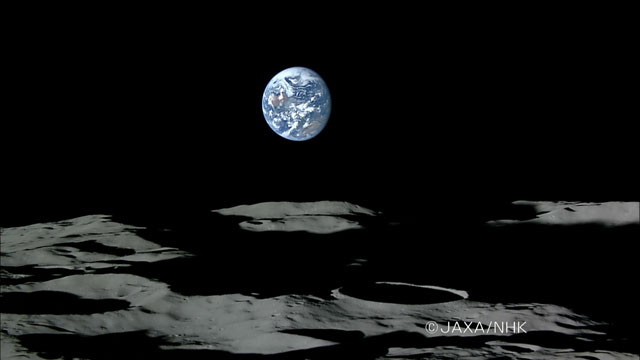
Courtesy of JAXA/NHK, one of the most enduring images of spaceflight recorded. Two actually: moonrise and moonset. (Above is an image from the Earth-set series.)
I particularly like their disclaimer about how the earth will never been seen to rise or set from an astronaut's perspective on the lunar surface: this is a unique view from orbiting satellites.
06 October 2007
Scientific Humour is such a wonderful thing
This is a classic that should endure for quite some time yet: chicken chicken chicken. Its iconic status is confirmed, with its author, Doug Zongker, giving the keynote address of this year's Ig Nobel Prize ceremony.
What I will give to attend the 18th First Annual Ig Nobel Prize Ceremony!
What I will give to attend the 18th First Annual Ig Nobel Prize Ceremony!
27 May 2007
Postcards from the Future
Oh why oh why did I forget all about the ISDC? According to Wired, the Indie film Postcards from the Future will premiere at the Conference.

More pictures from the movie site.
I still want to be an astronaut!
At the same time, take a look at this interactive on the past and future timeline of the universe. Simple enough to navigate (just point and click) yet profound enough to make you think. The 'Big Bang till Now' portion conforms to established scientific orthodoxy well enough (meaning I didn't cringe at any Bad Facts), thankfully. The future projections depend on your respective field of study, I believe.
Yet I can't help remembering Stalin's words, when paraphased, alas, 10^0 is a tragedy, 10^6 is a statistic, 10^100 is incomprehensible.
Go to Mars. Go. Go Now. Before the systematic despoilment of the Earth makes humanity culprit and victim on the 10^0 list.
24 April 2007
Quantum physics says goodbye to reality
So.... if "reality does not exist when we are not observing it (Nature 446 871)", does it mean that if I ignore a problem long enough it'd go away by itself?
Welcome to the weird and wonderful world of quantum mechanics.
Welcome to the weird and wonderful world of quantum mechanics.
26 January 2007
'Altruistic' brain region.
Too good not to be shared: the altruistic brain region. I'm sharing this with you altruistically, of course. Add this to the oxytocin spray (supposed to help increase trust level in/for strangers) and we will have a very trustworthy society indeed.
Hmm. Does this mean we should all start to lactate?
Hmm. Does this mean we should all start to lactate?
22 December 2006
Fourier Transforms (2)
I came across this statement in the print version of this article on a hypothetical elementary particle called an axion. The article is on a follow-up experiment to the PVLAS experiment using the double-pulsar system J0737 to test the birefringence of a strongly polarised beam of photons that had passed through a strong magnetic field. Regarding the delicate and exact calculations required to disentangle the change in polarisation (from linear to elliptical) from the effects of various frequency shifts owing to the double-pulsars' orbital and rotational effects...
Nice!
Owing to the appalling complexities of the timings involved, the system can be regarded either as a nightmare for normal human beings or as a dream case for Fourier-analysis buffs.
Nice!
07 October 2006
Camera sees Camera... on Mars.
A sublime moment when we actually see humanity's presence on the Red Planet: the Mars Reconnaissance Orbiter sees the Mars Rover Opportunity along Victoria Crater.
Isn't it beautiful? If for nothing else, enjoy the view of the crater. But I hope the intangible, intellectual beauty of the mere presence shines through.
I wonder when it will take for the pictures to start resembling a small settlement, town, city, metropolis, world.
Sublime.
Isn't it beautiful? If for nothing else, enjoy the view of the crater. But I hope the intangible, intellectual beauty of the mere presence shines through.
I wonder when it will take for the pictures to start resembling a small settlement, town, city, metropolis, world.
Sublime.
31 July 2006
You can multi-task, but don't expect to learn anything
I love the title of this article on the associated wetware processing that happens when you multitask. Moral of the story: FOCUS on one thing at one time if you want to learn effectively.
As though we don't know that. But it's always cool to have scientific evidence (wooooooo!) to back up the hypothesis.
Go, scientific method!
As though we don't know that. But it's always cool to have scientific evidence (wooooooo!) to back up the hypothesis.
Go, scientific method!
14 July 2006
Unskilled and unaware of it
A great research paper that I encountered some years ago. Good to find it again after so long. Read this. Very good reading, especially if you are in any sort of management or leadership role.
14 May 2006
Circle of friends
Returned from an industry conference in Perth: a nice one, thoroughly enjoyable, if somewhat tiring.
Found a Scientific American Mind Vo. 17 No. 2 on the magazine rack while at the Perth airport. There's a nice article on social circles as elaborated by psychologist Robin Dunbar. He postulates that social circles are hierarchial structures in the shape of concentric rings. In the inner ring is a hoop of three or four, or at most five people, whom we feel our greatest emotional connection to. This is the 'support group'. The next circle holds between 12-20 people with whom we maintain a caring mutual interest relationship. The subsequent level of 30-50 is looser still: these are people we have regular, if only occassional contact. Each circle's number of individual increases by approximately a factor of three. This can be seen in the arrangement of battle units in many countries. The smallest unit consists of 10-15 people, a platoon of 35 and a company of 120-150.
Did you, as you read the above paragraph, already started to populate your own social circle map with names?
A google (is your friend) reveals this article (quoting Dunbar) on the value of gossip. The arguments seems very logical, very scientific method even. Scary. Another nice article on gossip here.
I wonder what this says about the new media of blogs, podcasts, moblogs et. al. The new media at our disposal allows us to talk to potentially many people at once, yet time and again research as shown that new media's subscription is still rather niche. For example, many personal blogs have very small but dedicated readership, often comprising of a social grouping no larger than the second social circle. Are blogs the next incarnation of the quilting circle?
13 February 2006
Mind Hacks
Mind Hacks - Tips & Tools for using Your Brain - Stafford & Webb, published by O'Reilly
This is a great book, a not-so Dummy's Guide to the practical appreciation of the human brain, and how we can use it... better.
Positives
Full of wonderful, simple experiments about the senses... more specifically vision and hearing.
Full of usage of online materials for simple experiments. You know that your science museum has arrived when your online exhibits are listed alongside more serious experimental psychology studies.
Proper citations
And most importantly, the first scientific explanation (that I've seen, at least) of why putting a pen between your teeth makes you feel happier (Voluntary facial action generates emotion-specific autonomic nervous system activity Leverson, ekman, Friesen, Psychophysiology 27(4) 363-384), and why you should think that you are great, happy and confident -- and in a way giving some validity to all of that positive reinforcement self-help fairy dusts (concept priming, emotion as a social bonding/communication tool, contextual memory and all that autonomic responses to emotion... again)
Why caffeine addiction is less an addiction to the chemical compound itself, but more a conditioned response to the stimuli... and NO, I WANT FRESH MILK ONLY, not that curlish white thing you consider dairy
Negatives
What about studies that don't support the 100 hacks listed?
This is a great book, a not-so Dummy's Guide to the practical appreciation of the human brain, and how we can use it... better.
Positives
Negatives
25 January 2006
Space flight (part 2)
As a follow up to my previous post on Beauty in the Dark (regarding the BOT), here's a rather cool overview of the topic of space flight. And here are nice write-ups on the soon-to-be discarded Space Transportation System. ATO! AOA!
Would be really nice if the entire resource is available for archival download. :)
Would be really nice if the entire resource is available for archival download. :)
12 October 2005
Link between early stress and memory loss
This news article seem to suggest a scary trend, with stress levels increasing in the younger population of the world, what with competitive exams and competitive gaming environments...
What will happen if a quarter of the world has Alzheimer's? Hmm...
What will happen if a quarter of the world has Alzheimer's? Hmm...
18 September 2005
The Emperor's New Mind by Roger Penrose
*Spoiler Warning*
First, a warning of sorts: this book of 602 pages is not light reading. This strange hybrid of a philosophy treatise and a science text doesn't even have a very satisfying conclusion. For a book that sets out to answer, or at least attempt to answer, what consciousness is, the answer, when it came, lacked conviction. I'm sure that the author was convinced; the fault lies with the writing. Science communication (and I distinguish this quite clearly from communications between scientists: science communication to the lay-person is an art form, not an application of the scientific method) is not only about the transmission of information and knowledge: it is also about getting logical agreement and emotive buy-in from the reader. A popular science book that doesn't provide a good 'satisfying read' serves no one.
This is disappointing, for the background information Professor Penrose provided (which in a popular science book such as this one is essential to leading the non-expert to the the author's conclusion in an inevitable and logical way) is a good and solid introduction to the fundamentals of logic, artificial intelligence and modern (i.e.20th century) physics. It is unfortunate that the robust background information could not build up to a firm pronunciation (the author, was in the typical English gentleman way, far too apologetic) of Professor Penrose's belief that consciousness is non-algorthmic, (possibly) works because of non-local effects stemming from the Einstein-Poldolsky-Rosen paradox, does not cause vector-state reduction (refer to the 'Schrodinger's cat' thought experiment), and will require further improvements in our understanding of the Grand Theory of Everything (in which the marriage of quantum electrodynamics and general relativity is only the first step) before any description is possible.
Don't get me wrong: this book has its brilliant moments. The introduction to computing and Turing's Test is clear, and the arguments between a deterministic universe versus a computable universe compelling. The physics discourse is heartwarmingly nostalgic of my undergraduate course and actually taught me a new thing or two. The chapters on existing knowledge of the human brain and consciousness were well written and informative (though I wish there were more details). My favourite paragraph in the entire book is this:
This had me lean back on the chair to marvel at the idea that somehow, the very language that communicates this thought to me is the very embodiment of consciousness. This is a simple concept, yet it hides such complexity behind its 'obviousness'. What of dolphin consciousness/intelligence? What of two people speaking completely different languages? Surely there are ways of bridging the gaps! (Just imagine a first contact situation, where two aliens... sorry, beings.... are trying to learn from one another how each other counts.) And if so, does it not favour an objective universe, and not a subjective one? The sheer importance for the role of imagination in a subjective universe defies belief, and I'd go with Occam's Razor on this one.
In the fifteen years since this book was written, there has been progress in the field of super-string theory which goes some way to further explain the fundamental 'realities' of this universe we live in. My feel is that if Professor Penrose had these data back then, his arguments might have altered a little, but the fundamental arguments would still be the same. As our knowledge of clinical consciousness and the elementary (excuse the phrase... would 'fundamental' be better?) physics increase, how can we use science explain consciousness? With new, unknown science, it seems.
First, a warning of sorts: this book of 602 pages is not light reading. This strange hybrid of a philosophy treatise and a science text doesn't even have a very satisfying conclusion. For a book that sets out to answer, or at least attempt to answer, what consciousness is, the answer, when it came, lacked conviction. I'm sure that the author was convinced; the fault lies with the writing. Science communication (and I distinguish this quite clearly from communications between scientists: science communication to the lay-person is an art form, not an application of the scientific method) is not only about the transmission of information and knowledge: it is also about getting logical agreement and emotive buy-in from the reader. A popular science book that doesn't provide a good 'satisfying read' serves no one.
This is disappointing, for the background information Professor Penrose provided (which in a popular science book such as this one is essential to leading the non-expert to the the author's conclusion in an inevitable and logical way) is a good and solid introduction to the fundamentals of logic, artificial intelligence and modern (i.e.20th century) physics. It is unfortunate that the robust background information could not build up to a firm pronunciation (the author, was in the typical English gentleman way, far too apologetic) of Professor Penrose's belief that consciousness is non-algorthmic, (possibly) works because of non-local effects stemming from the Einstein-Poldolsky-Rosen paradox, does not cause vector-state reduction (refer to the 'Schrodinger's cat' thought experiment), and will require further improvements in our understanding of the Grand Theory of Everything (in which the marriage of quantum electrodynamics and general relativity is only the first step) before any description is possible.
Don't get me wrong: this book has its brilliant moments. The introduction to computing and Turing's Test is clear, and the arguments between a deterministic universe versus a computable universe compelling. The physics discourse is heartwarmingly nostalgic of my undergraduate course and actually taught me a new thing or two. The chapters on existing knowledge of the human brain and consciousness were well written and informative (though I wish there were more details). My favourite paragraph in the entire book is this:
"Many philosophers and psychologists seem to take the view that human consciousness is very much bound up with human language. Accordingly, it is only by virtue of our linguistic abilities that we can attain a subtlety of thinking that is the hallmark of our humanity - and the expression of our very souls. it is language, according to this view, that distinguishes us from other animals, and so provides us with our excuse for depriving them of their freedom and slaughtering them when we feel that such need arises. It is language that allows us to philosophize and to describe how we feel, so we may convince others that we possess awareness of the outside world and are aware of also ourselves."
This had me lean back on the chair to marvel at the idea that somehow, the very language that communicates this thought to me is the very embodiment of consciousness. This is a simple concept, yet it hides such complexity behind its 'obviousness'. What of dolphin consciousness/intelligence? What of two people speaking completely different languages? Surely there are ways of bridging the gaps! (Just imagine a first contact situation, where two aliens... sorry, beings.... are trying to learn from one another how each other counts.) And if so, does it not favour an objective universe, and not a subjective one? The sheer importance for the role of imagination in a subjective universe defies belief, and I'd go with Occam's Razor on this one.
In the fifteen years since this book was written, there has been progress in the field of super-string theory which goes some way to further explain the fundamental 'realities' of this universe we live in. My feel is that if Professor Penrose had these data back then, his arguments might have altered a little, but the fundamental arguments would still be the same. As our knowledge of clinical consciousness and the elementary (excuse the phrase... would 'fundamental' be better?) physics increase, how can we use science explain consciousness? With new, unknown science, it seems.
11 September 2005
Tacet! Tacet! Tacet!
John Cage's most infamous composition was his 4'33". Read a review of the performance here.
Only if there are more of such innovative music around. Where else in this busy, noisy world will we be able to enjoy the tinnitus of an abnormally quiet space?
So, What's the frequency of your tinnitus response?
Only if there are more of such innovative music around. Where else in this busy, noisy world will we be able to enjoy the tinnitus of an abnormally quiet space?
So, What's the frequency of your tinnitus response?
27 July 2005
BOT: the Beauty in the Dark
Caught a bit of NASA TV on BBC World, which was covering the Space Shuttle Discovery's Return to Flight launch. At about 8 minutes or so into the launch, a nice shot of the belly of the orbiter from a camera mounted on the External Tank (also known as the Big Orange Thing or BOT) appeared on the telly. Earth dominated the lower left of the screen, the curve horizon evocative of the fragility of the present and promise of the future. That beautiful, beautiful blue marble upon which we ALL depend.
Then the Big Orange Thing jettisoned, and the orbiter just floated away ever so quickly but ever so gently, peeling away from the Big Orange Thing like a whale swimming away from the observer in a dark ocean with stately grace. What a beautiful sight. You can see the video from here (or at least a still if your system doesn't take *.ram).
Beautiful. We need more moments of beauty like this in this world of ours.
03 June 2005
Starting the blog with an Earth Shattering ... plop?
I have been pondering on what topic to start this blog with, when the answer presented itself in a funny, intelligent, and most importantly, as-of-now-scientifically-accurate description of 'How To Destroy the Earth', courtesy of Mr Sam Hughes of Corpus Christi, Cambridge. To my delight [haha], Slacker Astronomy, one of my favourite podcasts, gave air to this topic in a hilarous podcast.
Evil Overlords, Take Note.
Those of you who have read my last fiction work would know why this is a particularly close topic to my heart. Hail maraudering asteroids! :)
Evil Overlords, Take Note.
Those of you who have read my last fiction work would know why this is a particularly close topic to my heart. Hail maraudering asteroids! :)
Subscribe to:
Posts (Atom)